
Hair transplant tourism has two dominant narratives: Turkey, and everywhere else.
Turkey has dominated the global hair transplant market for over a decade — extreme volume, aggressive pricing, slick marketing, and a patient pipeline that produces both outstanding results and cautionary tales in roughly equal measure.
Vietnam sits in an interesting position in this landscape. It’s not trying to compete with Turkey on price or volume. But for the patient who wants excellent results, a less industrial experience, and a destination they’d actually want to recover in — Vietnam is worth a serious look.
This guide covers what you actually need to know about getting a hair transplant in Vietnam in 2025.
The Vietnam Hair Transplant Market: What Exists
Ho Chi Minh City has a growing cohort of hair transplant surgeons who trained internationally — primarily in South Korea, France, and the US — and who are now building practices with international patients alongside their domestic clientele.
The Vietnamese domestic market for hair transplants has expanded significantly with rising incomes and a cultural shift toward male grooming and aesthetics. This means local demand is strong and surgeons are doing consistent volume — which matters for skill development and procedural fluency.
The result: HCMC has skilled FUE surgeons at price points well below Western countries and somewhat below Turkey, in a city that’s genuinely excellent to spend two weeks in. The International Society of Hair Restoration Surgery (ISHRS) maintains a global directory of verified member surgeons — a useful starting point when researching specific practitioners in Vietnam.
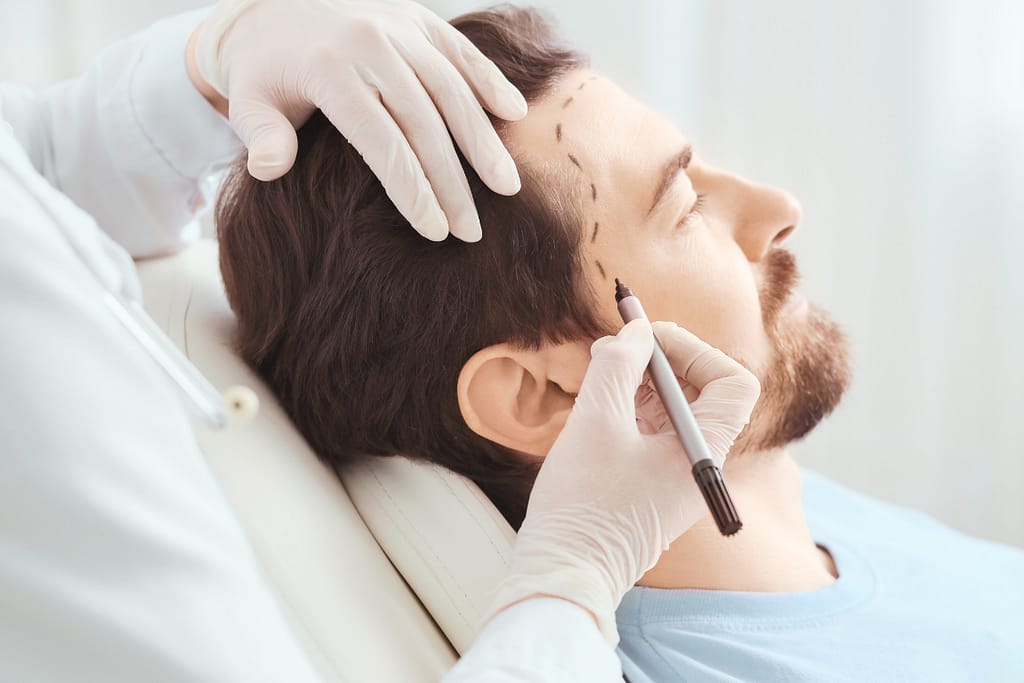
Understanding Hair Loss Before You Proceed
Before booking a procedure, it’s worth understanding where your hair loss currently sits on a standardised scale. The Norwood Scale is the most widely used classification system for male pattern baldness, ranging from Type I (minimal recession) to Type VII (extensive loss). Knowing your Norwood classification helps you understand:
- How many grafts you realistically need
- Whether your donor area has sufficient reserves for your target coverage
- Whether you are a good candidate for a single session or will need staged procedures
Hair loss is also often progressive. A surgeon who accounts for your likely future hair loss trajectory — not just your current pattern — is protecting your long-term donor reserves and giving you realistic expectations. This is one of the most important clinical conversations to have before committing to a procedure.
FUE vs. DHI: Which Technique?
Most reputable clinics in Vietnam offer both. The distinction matters for your graft count and your specific case.
FUE (Follicular Unit Extraction):
The current standard technique globally. Individual follicular units are extracted directly from the donor area (usually the back and sides of the scalp) and implanted into the recipient area. Recovery from the donor site is faster than older strip methods (FUT). Natural-looking results with an experienced surgeon. The ISHRS has a detailed patient resource on FUE that’s worth reviewing before your consultation.
DHI (Direct Hair Implantation):
A variation of FUE where the extracted grafts are implanted directly using a specialised pen (Choi implanter) without prior channel creation. Advantages: potentially higher density in smaller areas, less handling of grafts, reduced time grafts spend outside the body. Disadvantage: slower procedure for large graft counts, and requires a highly skilled team to execute well. Often recommended for hairline work or targeted density augmentation.
What to ask your surgeon: Given your donor density, scalp laxity, and target area — which technique do they recommend for your specific case, and why? A surgeon who recommends the same technique for every patient regardless of case specifics is not giving you individualised advice.
Cost | HAIR TRANSPLANT in Vietnam vs. The Alternatives
|
Procedure |
Vietnam (2025) |
Turkey (2025) |
UK/US (2025) |
|---|---|---|---|
| FUE 1,500 grafts | $900–$1,800 | $1,200–$2,500 | $5,000–$9,000 |
| FUE 2,500 grafts | $1,400–$2,800 | $1,800–$3,500 | $8,000–$14,000 |
| FUE 3,500 grafts | $2,000–$4,000 | $2,200–$4,500 | $11,000–$18,000 |
| DHI 2,000 grafts | $1,600–$3,200 | $2,000–$3,800 | $8,000–$15,000 |
| Beard transplant | $700–$1,500 | $900–$2,000 | $3,000–$7,000 |
| Eyebrow transplant | $600–$1,300 | $800–$1,800 | $2,500–$6,000 |
Turkey’s price advantage narrows significantly when you factor in flight costs from Australia, the UK, or North America, accommodation, and the overhead of Istanbul’s medical tourism infrastructure. For Australian patients especially, Vietnam is often geographically comparable to Turkey with meaningfully lower procedure costs and a significantly better recovery destination experience.
It’s also worth noting that pricing alone should never be your primary selection criterion. The hair transplant patient community at Hair Loss Talk and forums like Reddit’s r/HairTransplants contain extensive documented patient experiences — including outcome photos at 12 months — that can help you calibrate expectations and verify surgeon reputations before you commit.
HAIR TRANSPLANT IN Vietnam vs. Turkey | An Honest Comparison
TURKEY
ADVANTAGES:
- Extremely high procedure volume (Istanbul performs more hair transplants than any city globally)
- Aggressively competitive pricing
- Well-developed medical tourism infrastructure
- Many surgeons with 10,000+ case portfolios
REAL CONCERNS:
- The “hair mill” problem is well-documented. Many Istanbul clinics operate with surgeons doing 6–10 cases per day, with technicians performing the majority of extraction and implantation while the surgeon supervises. This is not illegal in Turkey, but it means patient-to-surgeon attention is limited.
- Quality variance is significant and not always predictable from online research
- The volume model creates an incentive to overextract from the donor area — permanently depleting reserves for future sessions
VIETNAM
ADVANTAGES:
- Surgeons typically performing their own procedures (not delegating to technicians)
- Lower volume means more individualized attention per patient
- Better recovery destination (city experience, food, comfort)
- Proximity advantage for Australian and Southeast Asian patients
LIMITATIONS:
- Smaller surgeon pool than Turkey — finding the right specialist requires more careful research
- Less English-language patient forum history for specific Vietnamese surgeons (though growing)
- Less established internationally recognized accreditation (requires active credential verification)
When researching clinics, check if your surgeon is a member of the International Society of Hair Restoration Surgery (ISHRS) to ensure they adhere to global ethical and clinical standards.
The bottom line: For patients who want results-focused care without Turkey’s factory model, hair transplant in Vietnam is a compelling alternative. For patients who have already identified specific Turkish surgeons with strong verified outcomes at the 12-month mark, that case-specific preference may reasonably override the general comparison.
What the Procedure Actually Looks Like
Day 0–1: Consultation and planning
Your pre-operative consultation establishes the hairline design (a collaborative decision — your input matters and you should assert it), graft count estimate, donor area assessment, and the procedure timeline. Many surgeons will do this via video call before you arrive; finalize in person the day before or morning of surgery.
Procedure day:
FUE for 2,000–3,000 grafts typically runs 6–10 hours depending on the technique and surgeon. You’re awake; local anesthesia keeps you comfortable. Many patients describe it as boring rather than painful — the extraction phase involves a mild pressure sensation; the implantation phase involves the Choi pen (DHI) or channel creation plus implantation (FUE).
You’ll be sitting or lying for most of this. Bring comfortable headphones and entertainment downloaded.
Immediately post-procedure:
Your scalp will be wrapped. You’ll receive detailed post-op instructions — follow them precisely. The first 48–72 hours are when grafts are most vulnerable to displacement. This means: no touching, no rubbing, sleeping in the specified position (usually semi-elevated to reduce swelling), no physical exertion.
Recovery Timeline
Days 1–3:
– Donor area (back/sides): mild soreness, redness
– Recipient area: grafts visible as small implanted hairs with scabs forming around the follicles
– Swelling may occur on the forehead on days 2–3 — this is normal and temporary
– No strenuous activity, no bending over, avoid direct sun on the scalp
– Sleep semi-elevated, on your back
Days 3–10:
– Scabbing around graft sites is normal — do not pick, rub, or scratch
– Gentle washing protocol begins around day 3–4 per surgeon’s instructions (specific shampoo, technique, water temperature)
– Redness in donor area subsides gradually
Days 10–14:
– Scabs begin to fall away naturally
– The transplanted hairs may begin to shed — this is expected and often misunderstood as failure. It is not. The follicles remain; the shaft sheds and new growth begins from the follicle.
Month 1–3:
– Most transplanted hairs shed (telogen effluvium phase)
– Donor area scar (if FUE) becomes largely invisible with normal hair length
– Follicles resting before new growth phase
Month 4–6:
– New growth begins emerging — thin, fine initially
– Significant visible progress by month 6
Month 12:
– Full results visible. This is the realistic timeline for final assessment — not 3 months, not 6 months.
For Vietnam stays: Most clinics require a 7–10 day post-op check before you travel home. Plan your return flight accordingly — do not book an early departure to save money on accommodation.
The Shedding Phase: Setting Expectations
The single biggest cause of patient panic after hair transplants is the shedding phase between weeks 2 and 8.
The transplanted hairs fall out. The scalp looks worse than before, or comparable to before. Patients who weren’t warned about this in detail assume something went wrong.
Nothing went wrong. The follicle is intact. The hair shaft sheds because the trauma of transplantation disrupts the hair cycle and forces the follicle into the resting (telogen) phase before the growth phase resumes. The new hair that grows from these follicles — beginning around month 4 — is the permanent result.
Ask your surgeon explicitly about this during your consultation. Get a clear description of what the shedding phase will look like for your specific case. Having this expectation set before it happens is the difference between waiting patiently and calling the clinic in a panic at week 3.
The American Academy of Dermatology has a useful overview of the hair growth cycle that helps contextualise why this phase occurs and what it means biologically.
Medications and Adjunct Treatments
Many patients undergoing hair transplant are also managing ongoing hair loss with medical treatments. This is worth discussing with your surgeon before the procedure.
Finasteride (Propecia): An oral DHT-blocking medication that slows or halts the progression of male pattern baldness in many patients. The evidence base for finasteride is well-established. Some surgeons recommend continuing or starting finasteride post-transplant to protect non-transplanted hair. Discuss this with both your hair transplant surgeon and your GP.
Minoxidil: A topical (and now oral) treatment that can promote hair regrowth and slow loss. Often used alongside or following transplant procedures. Available over the counter in most countries.
PRP (Platelet-Rich Plasma): Some clinics offer PRP therapy alongside hair transplant, where platelet-rich plasma derived from your own blood is injected into the scalp to potentially support graft survival and stimulate growth. Evidence is promising but not yet definitive — ask your surgeon for their specific perspective on whether it’s indicated for your case.
These treatments are not universally necessary, and your surgeon may have strong views one way or another. The point is to have the conversation before your procedure rather than after.
What Solo Travelers Need to Know
Hair transplant recovery is more manageable than many surgical recoveries — but it has specific demands that solo travellers need to plan for.
The first 48 hours: You cannot touch your scalp. You cannot sleep on your side or stomach. You need to eat, rest, and hydrate without disturbing the graft sites. Having someone check on you during this window is useful — particularly if you’ve had any sedation during the procedure.
Post-op washing: The specific technique your surgeon requires — water temperature, pressure, motion, drying method — matters directly for graft survival in the first week. Having a nurse experienced in post-hair-transplant care assist with this on days 3–7 meaningfully reduces the risk of accidental graft displacement.
Sun exposure: Your scalp needs protection from direct sun for weeks post-procedure. Vietnam is a hot, sunny country. This requires planning — loose hats with adequate space rather than tight caps, timing outdoor activities for early morning or evening, and being honest with yourself about how much you’ll actually adhere to these restrictions in a city you want to explore.
Physical activity: No gym, no sport, no heavy lifting for 2–4 weeks. Light walking from around day 5 or 6 is fine; anything significantly raising your heart rate or blood pressure is not.
Having local support: Managing medication schedules, wound care, follow-up appointments, dietary needs, and the practical logistics of recovery in a foreign city is harder than it sounds. International patients who arrange dedicated on-the-ground support — rather than managing everything solo from a hotel room — consistently report better recovery experiences.
Combining Hair Transplant With Other Procedures
Many patients travelling for hair transplant in Vietnam often combine the trip with other procedures — rhinoplasty, dental work, body contouring — to maximise the value of the journey.
This is generally feasible if procedures are spaced appropriately and recovery demands are compatible. Hair transplant and dental work can typically be done on the same trip with minimal conflict. Hair transplant and major surgical procedures (facelift, rhinoplasty, body surgery) require careful sequencing with adequate recovery time between each — rushing the timeline compromises outcomes for both procedures.
Discuss combination timing directly with both surgical teams before booking anything. Do not let travel logistics drive your medical sequencing.
Questions to Ask During Consultation
- Who performs the extraction and implantation — the surgeon, or technicians?
- What is your recommended technique for my specific case and why?
- What is your experience with my specific hair type (fine, coarse, curly, ethnic)?
- What graft count do you recommend and how did you arrive at that number?
- What is your assessment of my donor density and long-term donor reserves?
- What is your policy on the shedding phase — what’s normal, what warrants contact?
- What is your revision policy if results are unsatisfactory?
- Can I see before/after results for patients with similar hair loss patterns to mine?
The bottom line
Hair transplant in Vietnam is a legitimate, cost-effective option for patients willing to do the research to find the right surgeon. The savings versus Western countries are substantial — 60–80%. The comparison with Turkey is more nuanced: Vietnam offers individualized care and a superior recovery destination at comparable or slightly better pricing, with a smaller surgeon pool that requires more active verification.
The patients who come back with transformative results are the ones who verified credentials, asked direct clinical questions, set realistic timeline expectations, and arrived prepared for the specific demands of hair transplant recovery.
That preparation is the work. The outcome is the reward.
FAQ
How many days should I stay in Vietnam after the procedure?
Plan to stay for 7–10 days. Most clinics require a final post-op check during this window to ensure the grafts have stabilized before you fly home.
Is the procedure painful?
The procedure is performed under local anesthesia, so you should only feel mild pressure. Most patients describe the session as tedious or boring rather than painful.
When will I see the final results?
A full assessment can only be made at 12 months. While you will see significant progress by month 6, the hair goes through a shedding and resting phase before permanent growth begins.
What is the “Shedding Phase”?
Between weeks 2 and 8, it is normal for transplanted hairs to fall out. This is not a failure of the procedure; the follicles remain intact, and new growth will emerge starting around month 4.
How long must I avoid exercise and sun?
Avoid strenuous activity and heavy lifting for 2–4 weeks to prevent displacement of grafts. You must also keep your scalp out of direct sunlight for several weeks using a loose-fitting hat.
East Bridge Care helps international patients navigate surgery abroad in Asia — including pre-operative planning, post-op nursing care, accommodation, meals, and on-the-ground local support so you’re never managing recovery alone.
Planning a hair transplant in Vietnam involves more than booking a clinic. You’ll need to coordinate accommodation close to your surgical centre, arrange post-op nursing for the critical first 48–72 hours (when grafts are most vulnerable), manage your washing and wound care routine, and plan your diet and rest in a foreign city. The ISHRS patient guide on hair restoration and resources like Hair Loss Talk are useful starting points for understanding what the recovery process actually demands — but having dedicated local support makes a significant difference to outcomes and to the experience overall.
East Bridge Care works with vetted hair transplant surgeons across Ho Chi Minh City and can help you structure your full stay — from arrival through to your final pre-departure check. Whether you’re traveling solo or coordinating alongside other procedures, we’ll make sure the logistics don’t get in the way of your recovery.
Reach out to discuss your trip, and we’ll help you build a support plan around your specific procedure and timeline.
Disclaimer: This article is for informational purposes only and does not constitute legal advice. Always confirm course requirements with your attorney or court clerk before enrolling.